


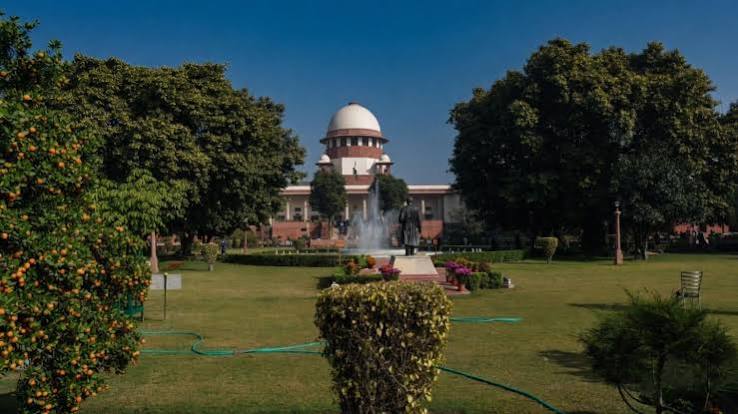
In a sharp rebuke to administrative authorities, the Supreme Court of India has expressed significant displeasure regarding the absence of essential pedestrian infrastructure, such as footpaths and crossings, in the immediate vicinity of the Delhi High Court. During a recent hearing, a bench comprising Justices JB Pardiwala and KV Vinod Chandran issued a stern warning to the Centre, indicating that the judiciary would not hesitate to take unconventional measures to ensure compliance if the matter remains unresolved.
Addressing Additional Solicitor General (ASG) Vikramjit Banerjee, the bench made its frustration clear, stating that if the required work is not completed before the next scheduled hearing, the judges themselves would sit on a 'dharna' at the main gate of the Delhi High Court. The court asserted that it would not permit either the judges or the legal representatives to leave until the project is finished, emphasizing that the days of ignoring such civic obligations are over. The bench further warned that if local authorities fail to rectify the situation, the Chief Secretary of the Delhi Government could be summoned to provide an explanation for the ongoing oversight.
The court underscored that the availability of safe and unobstructed footpaths is not merely a matter of civic convenience but a fundamental right guaranteed under the Constitution. Citing Article 21, which protects the right to life, and Article 19(1)(d), which pertains to the freedom of movement, the judges maintained that pedestrian rights must take precedence over the requirements of motorised traffic. The bench categorically stated that infrastructure designed for pedestrians cannot be viewed as an optional component of road planning and must be treated as a mandatory element of public urban design.
Beyond the immediate issues surrounding the Delhi High Court, the Supreme Court has issued a broader directive affecting all states and Union Territories across the country. The top court ordered that all road projects must incorporate safe and clearly marked footpaths that remain free from encroachments. These mandates specifically require authorities to clear obstacles such as unauthorised stalls, illegal parking zones, discarded garbage, and improperly placed utility infrastructure like electricity poles, which frequently hinder pedestrian movement.
To ensure that these judicial orders are effectively implemented on the ground, the Supreme Court has directed the Centre to establish a central monitoring committee. This body will be tasked with overseeing compliance and ensuring that road development policies adhere to safety standards for those on foot. The court’s intervention highlights a growing judicial focus on urban planning failures that compromise public safety in major metropolitan areas.
This development follows a series of recent judicial inquiries by the Supreme Court into civic and public order issues, including the regulation of protest sites and environmental concerns during festive seasons. By taking a direct stance on the physical environment surrounding court premises, the judiciary is signaling a more proactive role in compelling executive accountability regarding urban infrastructure. The next hearing is expected to serve as a critical checkpoint to determine whether the government has taken tangible steps toward fulfilling these requirements.
As the administration moves to address these directives, the focus will likely shift to coordination between municipal bodies and the central government to remove obstructions near the Delhi High Court. For now, the legal community and the public await official action, with the bench’s warning regarding the 'dharna' underscoring the urgency the court attaches to pedestrian safety as a protected constitutional interest.








Comments