


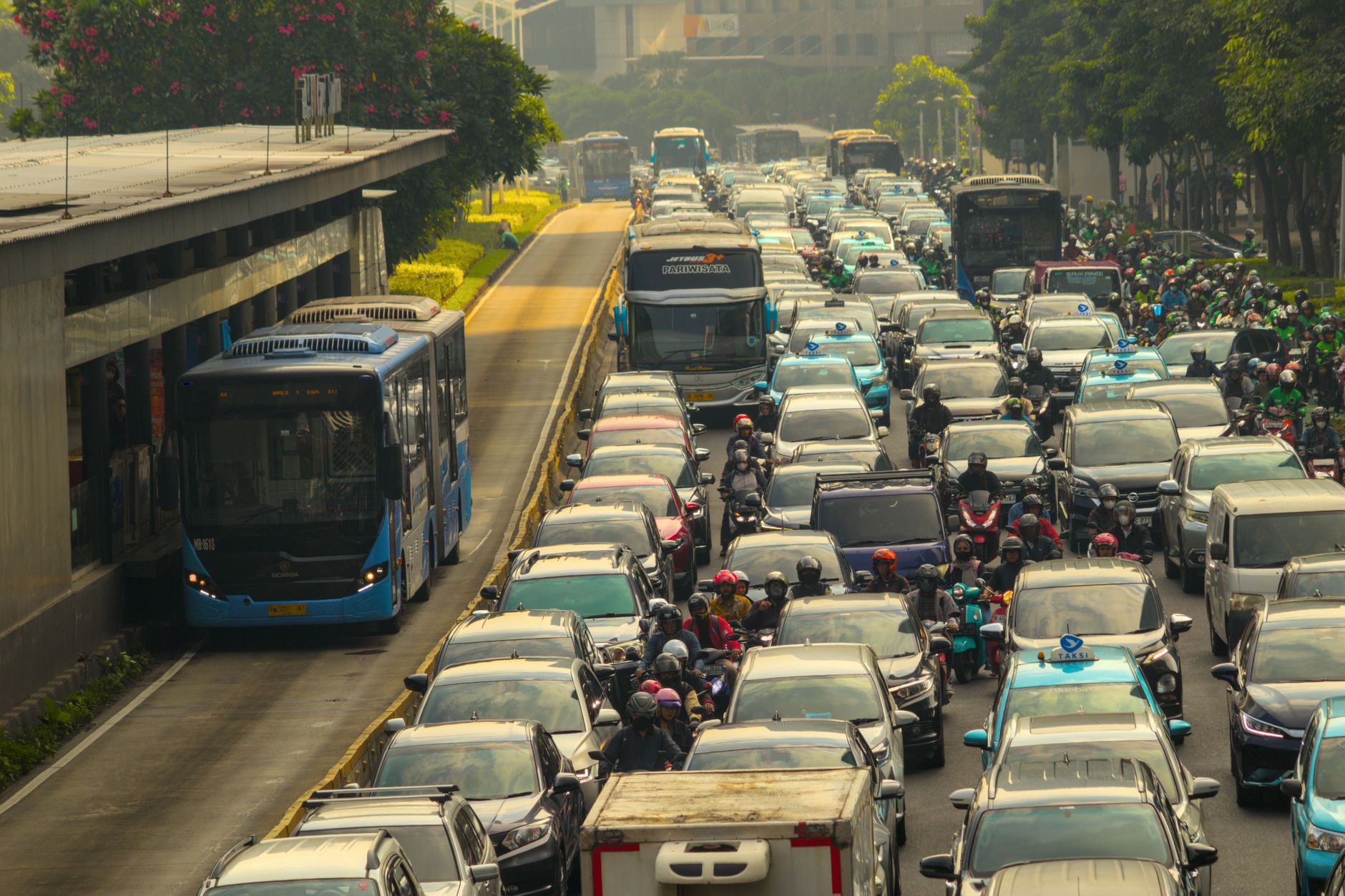
The Supreme Court of India expressed deep concern over the deteriorating air quality in Delhi and the National Capital Region (NCR), identifying vehicular emissions as a primary contributor to the crisis. During a hearing regarding the regulatory framework for air pollution, Chief Justice of India Surya Kant described the traffic situation in the capital as a "free-for-all," noting that "bumper-to-bumper" traffic persists despite various administrative efforts to mitigate the issue.
The bench, which also included Justices Joymalya Bagchi and V. Mohana, questioned why vehicular pollution levels remain high even with existing government interventions. Chief Justice Kant remarked that the lack of an efficient public transport system forces citizens to rely on private vehicles, which compounds the problem. The court pointed out that the volume of traffic is not limited to the winter months, asserting that the problem is a persistent, year-round issue that has not been adequately addressed by current infrastructure or regulatory planning.
Addressing the issue of out-of-state vehicles, the Court observed that Delhi currently lacks the mechanism to monitor the fuel quality or the mechanical condition of vehicles entering from other regions. Even if these vehicles only spend a short time in the capital, their contribution to the overall environmental degradation is significant. The Court emphasized that it is often those who use cars as a status symbol who exacerbate the situation, while the poor bear the brunt of the resultant health crisis.
Additional Solicitor General Aishwarya Bhati, representing the Commission for Air Quality Management (CAQM), informed the bench that multifarious efforts have been implemented to control polluting vehicles. She highlighted that pollution certificates are now geo-tagged and that fuel is not dispensed without a valid certificate. She further noted that entry restrictions for non-BS-VI vehicles are enforced during the winter season. When questioned about the persistent "very poor" air quality levels, Bhati argued that current measures have helped maintain pollution within certain limits, though the Court remained critical of the trend as the Air Quality Index (AQI) neared 400.
Regarding the controversy surrounding agricultural residue, the Court discussed the impact of stubble burning in the region. Senior Advocate Aparajitha Singh, serving as amicus curiae, stated that on November 5, stubble burning contributed approximately 14% to the pollution load. The Chief Justice noted that the stubble burning period is nearing its end and that the practice is gradually reducing. The bench suggested that in order to address this effectively, farmers should be offered practical alternatives and economic incentives, with procurement agencies purchasing crop residue at pre-notified rates.
The hearing highlighted the complexity of managing pollution in a growing urban centre that attracts talent and residents from across the country. While the administration points to mass rapid transportation and a shift toward renewable energy as long-term solutions, the Court insisted that immediate, tangible results are lacking. The bench reiterated that previous methods, such as infrastructure-focused solutions or partial vehicle curbing, have largely failed to curb the pollution effectively.
As the winter season progresses, the Supreme Court continues its suo motu examination of the air quality framework. The deliberations reflect a growing tension between urban growth, the lack of robust public transport, and the urgent environmental necessity of reducing pollutants. For now, the administration faces the challenge of reconciling its existing measures under the Graded Response Action Plan with the reality of increasing vehicle density on Delhi’s roads.








Comments