


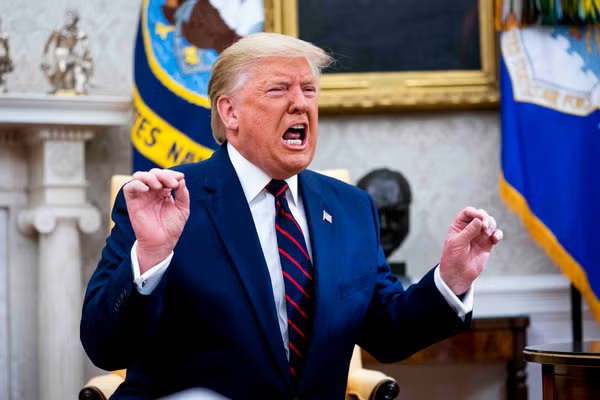
Former President Donald Trump engaged in a tense confrontation with a member of the press during a recent public appearance, resulting in an abrupt command for the reporter to remain silent. The incident, which was captured by news cameras, occurred as the journalist attempted to direct a question toward the former President, who responded with visible frustration and annoyance, effectively shutting down the line of inquiry.
The interaction highlights the often adversarial relationship between Donald Trump and the media, a dynamic that has persisted from his time in the White House through his post-presidency campaigns. As the reporter tried to secure a response, Mr. Trump immediately bristled at the interruption, raising his voice to insist that the individual stop talking. The exchange lasted only a few moments, yet it quickly drew attention due to the direct and forceful nature of the interaction.
Public figures often navigate complex interactions with the press, but this specific encounter serves as a reminder of the heightened friction that frequently characterizes such moments. Mr. Trump, who has frequently labeled mainstream media coverage as unfair or biased, often utilizes these public briefings to set the tone for his interactions with journalists. By demanding silence, he reasserted control over the format of the event, though the move inevitably drew scrutiny regarding the nature of political discourse.
While press briefings are traditionally intended to facilitate a flow of information between officials and the public, they have increasingly become arenas for direct conflict. The reporter's attempt to pose a question is standard practice in democratic processes, where journalists act as conduits for public interest. By refusing to answer and instead berating the individual, the former President bypassed the traditional inquiry-response mechanism, choosing instead to suppress the question entirely.
Observers of political media dynamics often note that such clashes are not isolated events. Over the past decade, the rapport between high-ranking political figures and the Washington press corps has undergone significant strain. These moments of tension are frequently viewed by supporters as evidence of a strong stance against a media establishment, while critics often frame them as an attempt to evade accountability or limit transparent communication.
The broader implications of such interactions continue to fuel debates about the role of the press in a healthy democracy. When lines of communication are closed by force of personality or directive, the public may lose access to critical answers regarding policy, campaign strategy, or personal controversies. The, now viral, footage of this exchange serves as a focal point for these ongoing discussions regarding how, and if, elected officials and candidates should be held to account during informal media availabilities.
As the campaign season progresses, it remains to be seen how these interactions will evolve. The incident underscores a recurring theme in the former President’s public life: a tendency to challenge the authority of journalists in real-time. Whether this serves as a strategic maneuver to energize a specific voter base or merely a reaction to the pressures of a high-stakes media environment, the impact on public perception remains a subject of intense analysis by political scientists and media experts alike.
Moving forward, the relationship between the former President and the various outlets covering his movements will likely remain confrontational. Journalists who cover such events are now well-versed in the possibility of being rebuked, yet they continue to persist in their efforts to obtain information. For now, the focus remains on this specific interaction, which serves as a stark illustration of the current climate of political communication in the United States.







Comments