


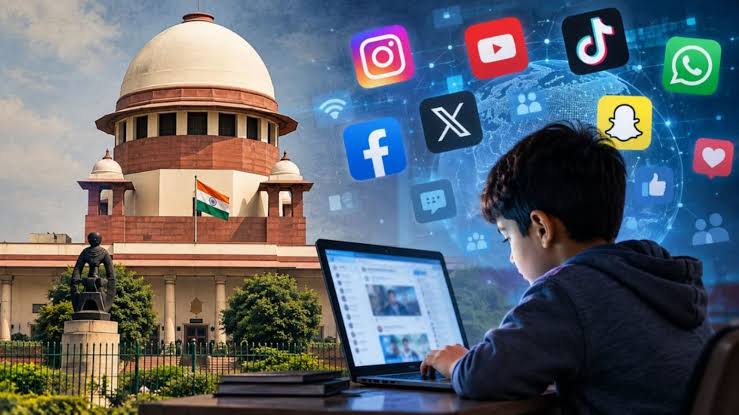
In a significant legal development, the Supreme Court of India has formally declared that access to and usage of the internet constitute a fundamental right for every individual, including children. A bench comprising Justice JB Pardiwala and Justice K Vinod Chandran delivered the observation on Saturday, grounding the ruling in Articles 21 and 19(1)(a) of the Constitution. The court emphasized that the safety of children and their fundamental right to digital freedom are not mutually exclusive concepts, arguing that children are entitled to both protection and online accessibility.
The court's observations were made while the bench was issuing directions aimed at strengthening the mechanisms required to detect and remove child sexual exploitation and abuse material (CSEAM) from various social media platforms and online services. Rather than suggesting a total denial of internet services to minors—which the judges described as an act of mistaking the victim for the problem—the court recommended that online platforms adopt a 'child mode' for social media accounts to bolster security for younger users.
Addressing the concern of shielding children from harmful online environments, the justices noted that imposing blanket restrictions is not a viable solution. The court highlighted that Article 19(1)(a) of the Constitution, which guarantees the right to freedom of speech and expression, inherently includes the right to receive and impart information. By framing the internet as a vital 'marketplace of ideas,' the bench argued that denying access would be as absurd as claiming that children do not possess a conscience worth protecting or a voice worth expressing.
The ruling underscored that the internet serves as a critical infrastructure for learning, communication, and creative expression. For many children residing in remote or underdeveloped areas, digital access is often their primary, if not sole, source of information and education. Furthermore, the court acknowledged that for children with special needs, the internet often provides a unique and essential space for building companionship and finding communities facing similar circumstances.
This landmark decision builds upon the foundation of several previous legal precedents. The bench referenced the 2020 judgment in the case of Anuradha Bhasin v. Union of India, which had previously established that freedom of speech and expression, as well as the freedom to conduct trade or business through the internet, are constitutionally protected. While that earlier judgment did not explicitly define internet access itself as a fundamental right, the current ruling marks a decisive step forward in legal interpretation.
The court also drew upon its 2025 decision in Pragya Prasun & Ors. v. Union of India, which had already recognized digital access as a component of the right to life under Article 21. By reinforcing these previous rulings, the bench has clarified that the digital landscape is not merely a tool for utility but an essential sphere of human activity that the state and private platforms must preserve with both freedom and safety in mind.
As the legal framework continues to evolve, the suggestion of a 'child mode' places the onus on social media companies to better police their platforms. The court expects that these entities will refine their technologies to filter out abusive content more effectively, ensuring that the digital world remains a safe, accessible space for minors. This development marks a clear policy shift toward managed, secure inclusion rather than exclusionary digital policies.








Comments