


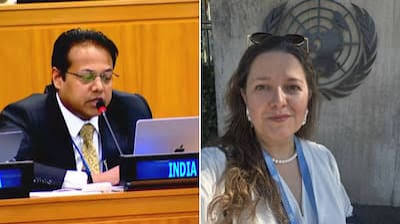
The Indian government has formally rejected allegations made by UN special rapporteur Gina Romero, who claimed that young people in the country are subjected to retaliation and stigmatisation for their views on mental health and gender justice. The rejection was delivered during an interactive dialogue at the 81st session of the UN General Assembly’s Third Committee.
India’s first secretary, Anuj Swarup, led the rebuttal, questioning the credibility of the evidence presented in the rapporteur's report concerning freedom of assembly and association. Swarup argued that the claims were based on anonymous, unverified submissions rather than rigorous research. He explicitly stated that such “arbitrary report writing” undermines the credibility of UN institutions, dismissing the assertions as hearsay disguised as an official report.
During his address, Swarup emphasised that the Indian Constitution guarantees fundamental rights, including freedom of speech, expression, and association. He noted that these rights are safeguarded by a free press, an independent judiciary, and the National Human Rights Commission. He challenged the premise of the report by highlighting instances of active youth engagement in the Indian political landscape. Referring to youth-led political movements, he questioned, “In which repressive state does a satirical youth party question the government, marches on the capital, and then sits across the table with senior national leaders?”
The rapporteur’s allegations had gained public attention following social media posts on October 10, in which she claimed that peaceful protesters faced excessive force and arbitrary detention. Her report further alleged that over 2,500 individuals had been held in remote detention centres without legal support, with some cases involving accusations of physical or sexual assault. Additional claims included the deletion of protest-related materials and restrictions on internet access. The Indian delegation firmly rejected these characterisations, noting that they were not independently established facts.
In response to the broader criticisms regarding the state's handling of student demonstrations—specifically those concerning alleged irregularities in public examinations and recent protest movements—India highlighted its proactive policy measures. Swarup pointed to the recent legislative amendments to the Public Examinations Act, which included a doubling of punishments for paper leaks. He also noted the state's initiative to establish fast-track courts across the country to specifically handle cases of examination fraud.
Further defending the government's approach to youth engagement, the delegation highlighted the success of the Viksit Bharat Young Leaders Dialogue. According to the government, over five million young participants have engaged with the initiative this year, allowing them to contribute directly to national priorities through discussions with senior leadership. Swarup asserted that this level of interaction contradicts the narrative of a government unresponsive to its youth.
Concluding his remarks, the Indian representative urged the special rapporteur to uphold higher standards of fairness and professional rigour in future reporting. He warned that generalising conditions for 1.4 billion people based on anonymous inputs does a disservice to the mandate held by the rapporteur. “We urge this special rapporteur to verify before she vilifies,” Swarup stated, reiterating that the delegation formally rejects the allegations in their entirety.








Comments