


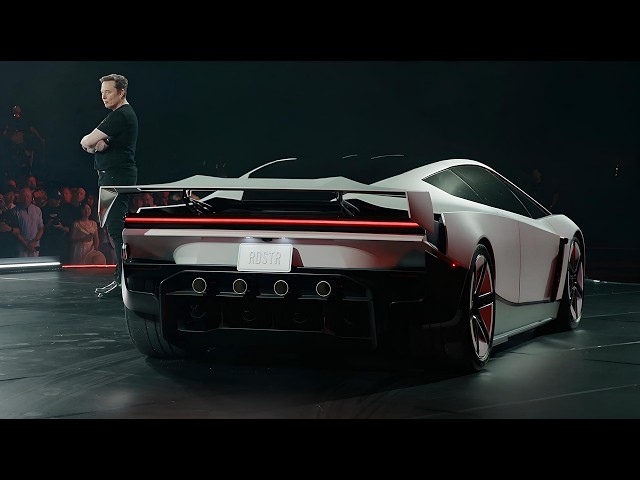
Tesla has officially unveiled a redesigned version of its long-awaited next-generation Roadster, marking a significant milestone nearly nine years after the initial prototype of the electric sports car was first introduced. The reveal took place during a demonstration at a SpaceX test site in McGregor, Texas, on October 15, 2026. The new model showcases advanced engineering, including built-in thrusters that facilitate unique, flying-car-like movements.
During the event, the company demonstrated the vehicle’s unconventional capabilities, which were developed in collaboration with Elon Musk's rocket firm, SpaceX. The presentation included a segment where the car drove upside down on a ramp, secured by a suction system, and performed mid-air turning maneuvers before landing with the assistance of its integrated thrusters. While the demonstration highlighted these extreme functions, the company has not yet clarified the practical usage or the legal status of such features for operation on public roadways.
In terms of performance, Tesla indicated that the new Roadster is designed to accelerate from zero to 60 miles per hour in less than one second and reach a top speed exceeding 230 mph. These figures follow previous claims by Musk, who had stated the four-seat version would offer a driving range of 620 miles, or approximately 1,000 kilometers, on a single charge.
The journey of the second-generation Roadster has been marked by significant delays. After a prototype was first showcased in 2017 with initial delivery promises for 2020, the project faced multiple setbacks. Following the latest announcement, the company has set the expected production timeline for 2028. This extension pushes the vehicle's arrival several years beyond its originally anticipated release window.
Although the vehicle generates significant interest, Elon Musk has previously noted that the Roadster is not expected to be a primary driver of the company’s financial success. In 2023, he characterized the project as a minor venture that would not fundamentally shift the automaker's financial trajectory. Conversely, industry analysts see the car as a strategic "halo vehicle." Seth Goldstein, an analyst at Morningstar, noted that the Roadster serves to showcase Tesla’s best engineering and technology, helping to bolster the company's premium brand identity. Analysts estimate an annual sales volume of approximately 2,000 units.
The focus on the Roadster arrives as Tesla shifts its corporate strategy toward broader technological frontiers, including artificial intelligence, robotics, and autonomous systems. This strategic pivot is evident in recent corporate moves, such as the discontinuation of the Model S and Model X to prioritize production capacity for Optimus humanoid robots, alongside the introduction of the Cybercab, a two-seat robotaxi that lacks traditional steering and manual driving controls.
The original Roadster, which launched in 2008 and remained in production until 2012, was Tesla's inaugural electric vehicle. Built on a Lotus Elise chassis, it was instrumental in changing public perceptions regarding the performance limits of electric cars. With this new iteration, Tesla aims to move beyond standard electric vehicle production to demonstrate its expanded technological ambitions in the competitive automotive market.







Comments