


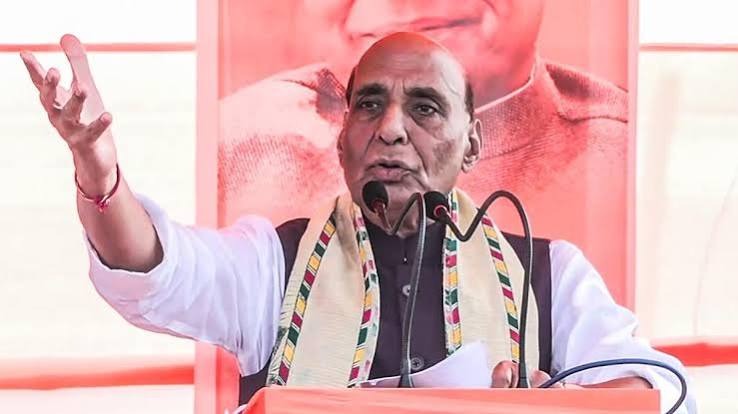
Defence Minister Rajnath Singh has launched a scathing attack on the opposition INDIA Bloc and the Cockroach Janata Party (CJP), accusing them of fostering an environment of instability in the country. During a press conference held in Lucknow, Uttar Pradesh, the senior minister asserted that the ongoing protests directed at Chief Election Commissioner Gyanesh Kumar are part of a broader attempt to destabilize the government and create chaos.
Addressing reporters, Singh issued a direct message to Congress leader Rahul Gandhi, stating that democracy does not provide a license to spread anarchy or undermine the credibility of the nation's constitutional institutions. He cautioned that such efforts to obstruct the country’s development trajectory in pursuit of regime change are detrimental to the democratic framework. "I would like to say that Rahul Gandhi and his associates must understand that democracy is not a license to spread chaos, undermine the credibility of constitutional institutions, or obstruct India’s development journey," the minister remarked.
The Defence Minister further alleged that the opposition is actively misguiding the youth, using them as "pawns" for political leverage rather than channeling their energy into productive nation-building activities. Singh specifically referenced recent comments made by AISA president Neha Bora regarding the situation in Bangladesh, suggesting that these sentiments are symptomatic of a larger agenda led by the INDIA Bloc and the CJP to dismantle democratic pillars. He claimed that the sole objective of these groups is to set the country on fire for political self-interest.
Highlighting his concerns regarding the rule of law, Singh noted that recent observations by the Supreme Court reinforce the need to maintain order. He emphasized that respecting legal processes is essential and that democratic institutions should not be sacrificed at the altar of partisan politics. In his view, the path chosen by the opposition represents a "politics of disruption" that stands in stark contrast to the values of a stable and functioning democracy.
To contextualize his criticism of the Congress, Singh drew upon the party's historical record. He cited the imposition of the 1975 Emergency, which he described as "putting democracy behind bars," and the 1984 anti-Sikh massacres following the assassination of former Prime Minister Indira Gandhi as evidence of the party's past challenges with democratic norms. Furthermore, he alleged that the Congress had historically treated the Election Commission as a subordinate entity, pointing to sudden structural changes made to the poll body in 1993 and the alleged shielding of former Election Commissioner Naveen Chawla from legal scrutiny despite formal complaints.
The opposition's current protests, which have drawn the government's sharp rebuke, are reportedly centered on concerns regarding electoral irregularities and the Special Intensive Revision exercise of electoral rolls. While the opposition maintains that its actions are intended to protect the integrity of the voting process, the ruling establishment views these mobilizations as a coordinated effort to create an artificial crisis of confidence in independent bodies.
As the political temperature rises, Rajnath Singh’s remarks reflect a hardening stance from the Union government against the opposition's protest tactics. The government maintains that such agitation undermines the mandate given by the people, while the INDIA Bloc continues to demand accountability from constitutional offices. With both sides standing firm, the debate over the limits of political protest and the autonomy of the Election Commission remains a focal point of the current national discourse.








Comments