


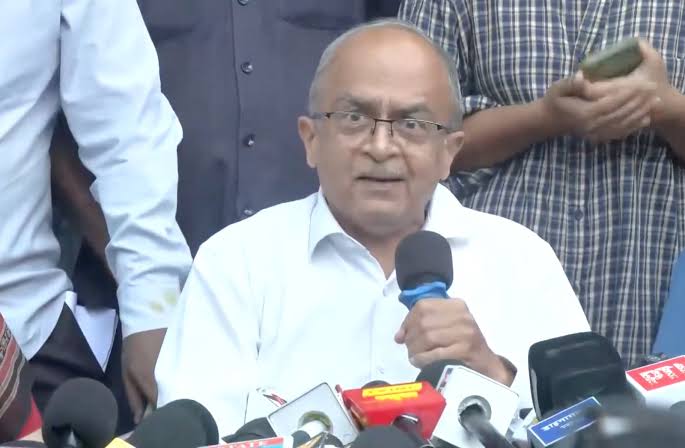
Lawyer-activist Prashant Bhushan has publicly declared that his ongoing efforts are centered on achieving a regime change in India. During a recent press conference, Bhushan addressed the objective directly, stating, “Yes, we want regime change... What is wrong in this? I am saying today that yes, it is a battle for regime change, and we will get it done anyhow.” His remarks have drawn a swift and stern reaction from the Bharatiya Janata Party (BJP), which characterized the comments as evidence of a broader plan to destabilize the nation’s democratic framework.
The controversy emerged following statements made by AISA leader Neha Bora, who serves as a prominent face in the protests currently directed against the Election Commission’s Special Intensive Revision (SIR) process. In a video message, Bora referenced the recent political developments in Bangladesh, specifically the movement led by the country's youth, claiming that they had “shown the way” for a similar struggle in India. She asserted that the fight for democratic and voter rights, which culminated in the departure of the Sheikh Hasina government, is now a cause that resonates within the Indian context.
The BJP leadership moved quickly to challenge these assertions, framing the rhetoric as an attempt to bypass established electoral processes. BJP MP Sambit Patra criticized the statements, arguing that the activists’ true intent is to facilitate a coup. “Prashant Bhushan ji said this fight is for regime change and they will not rest until they bring about regime change… Their sole intention is to stage a coup in the country… to somehow form their own government without fighting an election,” Patra stated.
The ruling party also sought to link the current protest discourse with the opposition leadership. Pradeep Bhandari, the BJP media co-convener and national spokesperson, alleged a connection between the ideology of these activists and the Congress party. He pointed out that during a recent march led by Rahul Gandhi, Neha Bora was positioned as a significant figure. “This means that Neha Bora shares Rahul Gandhi’s ideology,” Bhandari claimed, suggesting that the explicit support for a movement modeled after the Bangladeshi uprising indicates a dangerous shift in protest politics.
The ongoing protests, which are the backdrop for this verbal sparring, concern the Special Intensive Revision of electoral rolls. While demonstrators maintain their fight is for “democratic and voter rights,” the central government and the BJP have consistently framed the agitation as an attempt to undermine institutional integrity. The focus on regime change as an explicit, achievable goal marks an escalation in the language used by the protest organizers, moving beyond specific policy grievances to a fundamental challenge of the current administration.
The situation remains fluid as both political sides continue to trade accusations. For the BJP, the rhetoric from Bhushan and Bora serves as proof that the protests are not merely about election administration, but are part of a calculated strategy to destabilize the government. For the activists, the declarations are seen as a bold assertion of their right to demand political change through organized public movements, regardless of how the ruling party interprets their motivations or long-term objectives.








Comments