


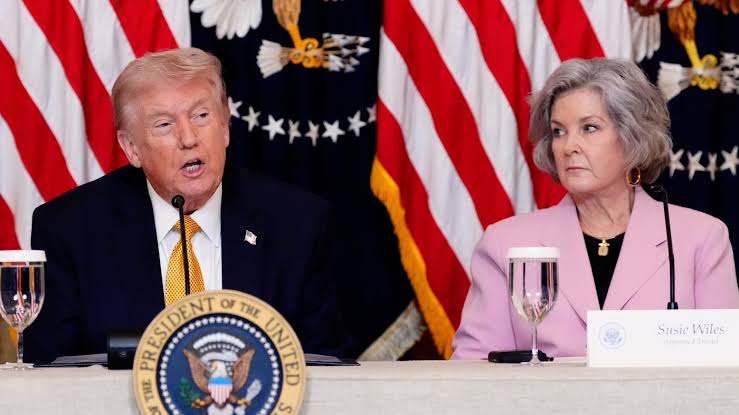
Former President Donald Trump has issued a sharp rebuttal to recent reports suggesting he is contemplating a change in his top White House leadership. Responding to claims that he is seeking a successor for his long-serving Chief of Staff, Susie Wiles, Trump dismissed the speculation as entirely inaccurate, asserting that Wiles remains his trusted advisor.
The controversy originated from a report by Politico, which alleged that Trump had consulted associates about the possibility of replacing Wiles. According to the publication, which cited four sources familiar with the matter, concerns had been raised by some Republican operatives suggesting that Wiles had alienated individuals within the administration. The report also provided a list of potential candidates for the position, including White House deputy chief of staff Stephen Miller, former House Speaker Kevin McCarthy, and various others such as Randy Levine, Steve Witkoff, and Bill Pulte.
Trump addressed the report directly in comments to The Hill, labeling the story as "total fake news." He criticized the outlet for a perceived lack of integrity, stating that such journalism was the reason he had previously restricted their access to the White House. Highlighting Wiles' tenure and loyalty, the former president remarked, "Susie Wiles is my loyal and longest serving Chief of Staff—there is a reason for that. She has been with me since the beginning, is my trusted advisor, and has my COMPLETE confidence."
Susie Wiles, a veteran political strategist from Florida, holds the distinction of being the first woman to serve as Trump's Chief of Staff. Her tenure has been marked by a disciplined approach to her duties, even while navigating personal health challenges. Earlier this year, she received the "Woman of Valor" award. At the time of receiving the honor, she noted that she had received a cancer diagnosis nine weeks prior but continued to attend to her work daily, emphasizing that she does not complain and aims to lead by example.
The emergence of these reports occurs within a high-stakes timeframe, falling just three weeks before the November 3 midterm elections. The Republican Party is currently engaged in efforts to retain its congressional majority in several highly competitive races. These political contests are unfolding against a backdrop of several domestic and international pressures, including concerns over inflation, rising fuel costs, and public unease regarding American military involvement in Iran.
While the administration remains focused on its campaign agenda, the media discourse surrounding staff stability highlights the intense scrutiny directed at the inner circle of the former president as he navigates these electoral challenges. Stephen Miller, who currently serves as the deputy chief of staff for policy and a Homeland Security adviser, remains a prominent figure often mentioned in discussions regarding the administration's direction, particularly concerning immigration and deportation initiatives. Meanwhile, candidates like Randy Levine, the president of the New York Yankees, have been noted as potential successors who lack current formal government affiliations.
Despite the circulation of these names, Trump’s strong public defense of Wiles indicates an intention to maintain current leadership as the party approaches the upcoming election cycle. For now, the administration appears to be positioning itself against external reports, focusing on the preservation of its legislative goals and the stability of its senior personnel during a critical period of campaigning.








Comments