


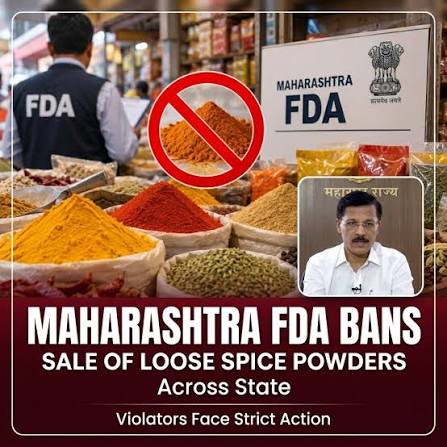
The Maharashtra Food and Drug Administration (FDA) has announced a significant regulatory crackdown on the spice industry, officially banning the sale of all loose and unpacked spice powders and mixed spices. Commissioner Tukaram Mundhe stated that the new directive makes it mandatory for spice products to be properly packaged and sealed directly at the place of production. This move is designed to enhance traceability and curb the widespread risks of adulteration and contamination that have historically plagued the market for bulk food products.
This comprehensive order applies to a wide range of industry participants, including manufacturers, traders, wholesalers, retail sellers, e-commerce platforms, hotels, catering services, and institutional kitchens. The affected items include commonly used culinary staples such as turmeric, chilli, coriander, cumin, black pepper, cinnamon, cloves, cardamom, asafoetida, saffron, poppy seeds, garam masala, and various spice blends. According to the FDA, businesses must now ensure their operations are compliant with these heightened safety protocols, which extend from production and processing to storage, transportation, and final distribution.
A critical component of the new order is the prohibition of ethylene oxide, a flammable and colourless gas previously used for spice sterilisation. The regulator noted that this step is necessary due to concerns regarding the substance's potential carcinogenic effects. Furthermore, the FDA has reiterated its stance against the use of harmful and unauthorised additives, including Lead Chromate, Metanil Yellow, Sudan dyes, and Rhodamine B. The commissioner warned that any attempt to bulk up products using brick powder, chalk, sawdust, or foreign starches will face strict punitive measures.
The mandate also sets stringent hygiene standards for premises where spices are processed. The regulator has explicitly banned drying spices on public roads, near drains, garbage bins, or close to cattle sheds. Production areas must remain clean, dry, and pest-free, with a strict prohibition on storing pesticides, industrial chemicals, or unauthorised colours in the same vicinity as food products. Additionally, all businesses involved in spice production must hold a valid FSSAI licence, as the FDA has clarified that standard trade licences are no longer sufficient for these operations.
On the packaging front, the new rules require detailed labelling on all spice packets. These must clearly display the product name, a full list of ingredients, manufacturer contact details, the FSSAI licence number, batch identification, and specific dates for manufacture and expiry. The order further restricts manufacturers from making unsubstantiated health claims or marketing products as 'natural' or 'organic' without verifiable evidence, warning that misleading labels will be treated as violations under the Food Safety and Standards Act, 2006.
The FDA intends to track potential adulteration by rigorously examining purchase and sales records, production logs, and the reconciliation of raw material quantities against finished products. Enforcement officers across the state have been instructed to conduct regular inspections of spice businesses. These officials are required to record findings in designated systems and submit monthly reports to senior leadership to ensure consistent oversight.
The consequences for non-compliance are severe, according to the commissioner. Authorities are empowered to seize contaminated food products, issue stop-sale orders, initiate product recalls, and suspend or cancel business licences. In instances of grave offences, the FDA will coordinate with the police and other competent agencies to pursue legal action. By centralising control over how spices are packaged and sterilised, the state government aims to provide consumers with greater assurance regarding the quality and origin of the spices they purchase.








Comments