


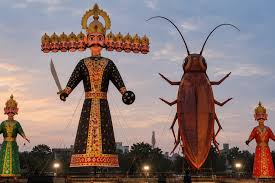
This year’s Dussehra celebrations in Delhi will feature an unconventional addition to the traditional effigy burnings. The Shree Keshav Ram Leela Committee, based in Pitampura, has announced that a 30-foot-tall effigy of a cockroach will be set on fire alongside the symbolic figures of Ravana, Kumbhkaran, and Meghnad. The committee members explained that the inclusion of the insect serves as a visual representation of “filth and dirt” to be eradicated.
According to the organisers, the decision to construct and burn the large insect structure is aligned with the broader goals of the Swachh Bharat and Swachh Delhi cleanliness initiatives. By incorporating the effigy into the annual ritual, the committee aims to deliver a message regarding public hygiene and environmental sanitation. The event, which takes place in 2026, has been a long-standing tradition in the Pitampura area, drawing large crowds annually to witness the symbolic victory of good over evil.
The timing of the announcement has sparked significant discussion, as the construction of the cockroach effigy coincides with a series of demonstrations held by the Cockroach Janata Party (CJP). The political group has been organising protests across Delhi and in various other cities throughout the nation. The proximity of these events has led to speculation regarding whether the Ramlila committee’s decision was influenced by the ongoing political developments and the activities of the CJP.
Addressing these concerns, the committee president and local BJP MLA, Ashok Goel, issued a clarification to the media. Speaking to the news agency, he stated that the decision to include the cockroach effigy was strictly for the purpose of promoting the cleanliness campaigns and was entirely apolitical in nature. He emphasised that the primary motivation remained centered on the themes of the Swachh Bharat mission rather than engaging in current political discourse or responding to the CJP’s protests.
Ramlila committees in the national capital often introduce creative or thematic elements to their Dussehra programmes to capture public attention and convey social messages. While the burning of Ravana, Kumbhkaran, and Meghnad remains the core focus of the festivities, the addition of contemporary symbols of social issues—such as dirt, pollution, or corruption—has become a recurring trend in urban celebrations. This year, the focus on urban cleanliness takes centre stage in the Pitampura event.
As the date of the festival approaches, the Shree Keshav Ram Leela Committee continues its preparations for the grand event. The effigy, standing at 30 feet, is expected to be a major highlight of the evening, serving as a distinct focal point for attendees. The organisers maintain that their initiative is intended to encourage community participation in local cleanliness efforts throughout the city.
The situation remains a developing story as local authorities and citizens observe the intersection of traditional religious pageantry and modern social activism. For now, the focus in Pitampura remains on the logistical arrangements for the upcoming effigy burning and the execution of the planned display aimed at supporting the government’s sanitation goals.








Comments