


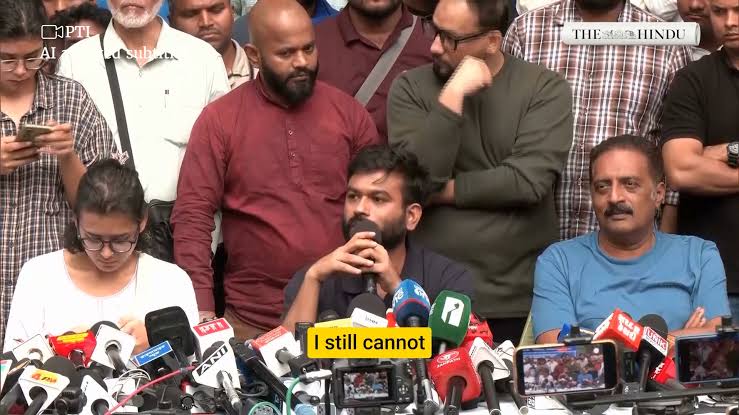
Cockroach Janta Party (CJP) founder Abhijeet Dipke held a press conference at the Press Club of India in New Delhi on Thursday to challenge the government’s response to ongoing protests surrounding Chief Election Commissioner Gyanesh Kumar. Dipke alleged that the administration had effectively brought the national capital to a standstill to shield the election official from public scrutiny.
The CJP has been actively campaigning for Kumar’s resignation, citing concerns over alleged irregularities in electoral processes and the Special Intensive Revision (SIR) exercise. Dipke specifically questioned the necessity of the extensive security deployment during the lead-up to an October 10 demonstration, noting that authorities had shuttered metro stations and disrupted railway services to manage the unrest.
Addressing the assembly, Dipke raised questions about the level of state protection afforded to the Chief Election Commissioner. He asked why student activists, political figures, and former chief ministers faced detention during the agitation. Among those noted by the organizers as having been impacted by the police response were senior opposition figures, including Mamata Banerjee, Arvind Kejriwal, and Pinarayi Vijayan.
Neh Bora, representing the All India Students Association (AISA), joined Dipke to reiterate that the movement is a broad struggle for democratic participation rather than the agenda of a single entity. Bora characterized the detention of CJP leaders such as Saurav Das and Ashutosh Ranka as a suppression of national voices regarding voting rights. Furthermore, she alleged that journalists covering the protests had been harassed, claiming that a woman reporter who attempted to file a complaint regarding sexual harassment was later named in a counter-FIR.
Legal and public figures also utilized the platform to express concerns regarding the integrity of the electoral rolls. Senior advocate Kapil Sibal voiced apprehension over the potential for arbitrary revisions and large-scale deletions to undermine constitutional institutions. Echoing these concerns, actor-activist Prakash Raj alleged that Form 7 was being utilized systematically to target and remove specific communities, particularly Muslim voters, from the electoral rolls, while highlighting difficulties faced by citizens in Karnataka who sought to raise their concerns.
The press conference featured a coalition of civil society members, student representatives, and legal experts, including figures like Prashant Bhushan, Aishe Ghosh of the SFI, and Viraaj of the AISF. The organizers maintained that the movement for electoral reform would continue if their demands for accountability regarding the SIR exercise and the conduct of the Chief Election Commissioner remain unaddressed.
While the CJP and associated activists have framed these events as a critical defense of democratic rights, the government, the police, and the Election Commission have faced the brunt of these accusations. The events of October 10, which saw the detention of several key organizers, serve as the backdrop for the current agitation. The claims made by the participants at the Press Club regarding the scale of the security measures and the reasons behind the electoral roll revisions remain points of contention as the movement seeks wider public participation.








Comments