


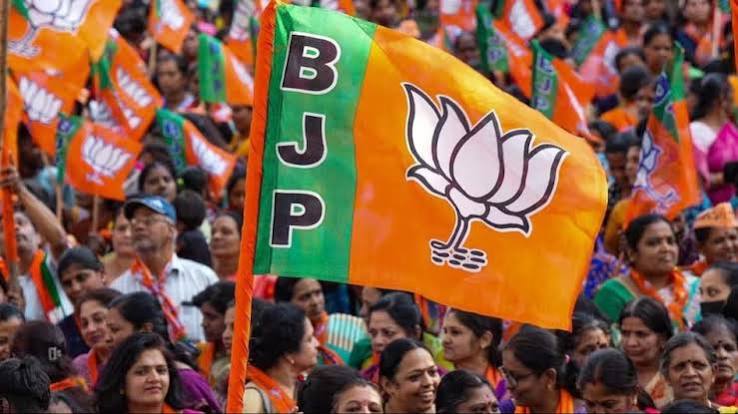
The Bharatiya Janata Party (BJP) has launched a sharp offensive against the Congress party, accusing it of attempting to destabilise Indian democracy. The ruling party claims the opposition is fostering a culture of anarchy, alleging that student leader Neha Bora—president of the All India Students’ Association (AISA)—is acting as a vehicle for a broader agenda led by Congress leader Rahul Gandhi. The controversy centres on recent public remarks made by Bora regarding the protests in Bangladesh.
Addressing a press conference in Delhi on Thursday, BJP national spokesperson Pradeep Bhandari asserted that the opposition’s calls for “political resistance” are merely a strategic mask for an objective of regime change. Bhandari alleged that the Congress leadership has shifted its focus from electoral competition to dismantling democratic institutions after failing to secure power through the ballot box. He stated, “You must have heard Rahul Gandhi using the term ‘political resistance’. The facts I am going to present before you today will prove that Rahul Gandhi’s objective is not democratic protest, but to destroy Indian democracy under the guise of anarchy.”
The criticism stems from recent statements attributed to Neha Bora, in which she reportedly suggested that the protest movement in Bangladesh serves as a model for India. Bhandari claimed that these remarks align with Rahul Gandhi’s own political ideology. During the press conference, the spokesperson referenced a video featuring both Gandhi and Bora at a protest, suggesting that the Congress leader has positioned Bora as a prominent face of the demonstration to promote their shared political vision. “In an interview yesterday, Neha Bora said that the movement was inspired by the Bangladesh protests and that they want the same thing to happen in India as happened in Bangladesh,” Bhandari added.
The BJP’s social media campaign has mirrored these accusations. On the platform X, formerly known as Twitter, Bhandari described Bora as the “poster girl” for Rahul Gandhi’s political movement. He further claimed that her statements provided an “open admission” of an intent to replicate the regime change seen in Bangladesh within India. According to the BJP, this rhetoric confirms that the Congress party is prioritising agitation and civil unrest over conventional public service and policy-based opposition.
Bhandari also invoked previous statements made by Rahul Gandhi, where the Congress leader claimed his fight was against the Indian state rather than specific organisations like the Rashtriya Swayamsevak Sangh (RSS). The BJP spokesperson used this to frame the Congress party's current activities as a direct threat to the stability of the nation. He urged young people to remain vigilant, claiming that the opposition's political ecosystem is attempting to legitimise chaos as a viable path back to power.
Other prominent BJP leaders have joined the chorus of criticism. In Ranchi, Jharkhand, party leader Pratul Shahdeo claimed that the controversy has “completely removed” the mask of the opposition, arguing that the movement in Bangladesh resulted in the collapse of an elected government through systemic anarchy. Shahdeo further alleged that Gandhi is granting more prominence to Bora than to members of his own party, suggesting a strategic coordination between the student leader’s activities and the Congress's political objectives.
Additionally, BJP Member of Parliament Praveen Khandelwal sharply criticised Bora’s stance, labelling her remarks as “anti-national.” He suggested that her comments regarding the government and the Election Commission spoke for themselves and that her future activities are being closely monitored. As the political rhetoric escalates, the BJP continues to position the controversy as a fundamental test of the opposition's commitment to India’s established democratic processes.








Comments