


China and North Korea Open New Yalu River Bridge After Years of Delay
The three-kilometre infrastructure project serves as a modern alternative to the aging Sino-Korean Friendship Bridge for cross-border commerce
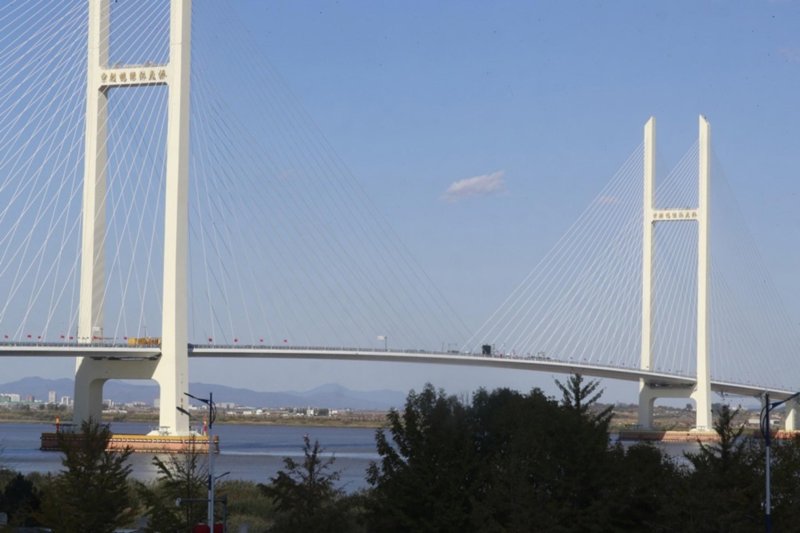
A long-delayed road bridge connecting China and North Korea has officially opened to traffic, according to reports from Chinese state media. The infrastructure project, known as the New Yalu River Bridge, spans three kilometres and links the Chinese border city of Dandong with Sinuiju in North Korea. The opening marks a significant development in the logistical ties between the two neighbours, serving as a modernised alternative to the decades-old Sino-Korean Friendship Bridge, which dates back to the era of Japanese occupation.The project, which was initially slated for completion and launch in 2014, faced a protracted period of uncertainty. Construction on the North Korean side, including essential road infrastructure and customs facilities, was indefinitely halted as diplomatic relations between Beijing and Pyongyang cooled during the 2010s. The revival of the project is seen by observers as a tangible sign of warming relations between the two long-standing allies, whose partnership is often described by the phrase "as close as lips and teeth."Addressing the launch on Wednesday, Chinese Foreign Ministry spokesperson Mao Ning described the crossing as an "important facility for connectivity." Mao noted that the route is expected to further facilitate trade and exchanges between the two nations. China continues to be North Korea’s primary trading partner, acting as a crucial economic lifeline amid international sanctions imposed due to Pyongyang’s nuclear weapons programme.Despite the optimism surrounding the opening, analysts suggest that the impact on regional trade may be tempered by broader geopolitical constraints. While bilateral trade reached approximately $2.7 billion last year—a recovery to pre-pandemic levels—this figure remains heavily reliant on Chinese exports. Kang Jun-young, a professor of Chinese studies at Hankuk University of Foreign Studies, noted that a sudden surge in cross-border trade is unlikely as United Nations sanctions remain in place.Furthermore, there is a strategic sensitivity regarding the volume of trade. Pyongyang remains cautious about the potential for a flood of Chinese imports to exert excessive influence over its domestic market. Consequently, experts anticipate that economic integration will likely proceed at a gradual pace rather than through an abrupt shift. This caution is balanced against the necessity of maintaining the bilateral alliance, which includes a mutual defence treaty—the only such agreement China maintains with any nation.The current climate marks a departure from the previous decade, during which Beijing was overtly critical of North Korea’s nuclear ambitions and frequently advocated for denuclearisation. Edward Howell, a lecturer at the University of Oxford, pointed out that China has recently shifted its stance, offering little public criticism of Pyongyang’s nuclear developments. This trend follows other signs of re-engagement, such as the resumption of direct Air China flights between Beijing and Pyongyang in March after a six-year hiatus, alongside the restoration of passenger rail services.The opening of the New Yalu River Bridge also occurs against the backdrop of China’s efforts to reassert its influence as North Korea builds closer ties with Russia. Relations between Pyongyang and Moscow have intensified significantly since the start of the conflict in Ukraine, with the two nations recently opening their own separate road bridge. Observers view the current bridge launch as a move by Beijing to reinforce its strategic relevance, particularly following President Xi Jinping’s state visit to Pyongyang in June.While the opening is a clear sign of improving bilateral relations, analysts caution against overestimating the ease of the partnership. Leif-Eric Easley, a professor at Ewha University in Seoul, observed that while the bridge demonstrates that Xi Jinping’s visit was more than symbolic, the long delay—exacerbated by North Korea’s pandemic-era isolation and domestic crackdowns—highlights the inherent challenges of dealing with Pyongyang as a partner.







Comments