


Government Renames National Social Assistance Programme, Rebrands Key Pension Schemes
Former Prime Minister Indira Gandhi's name has been dropped from three major social security sub-schemes under the new branding
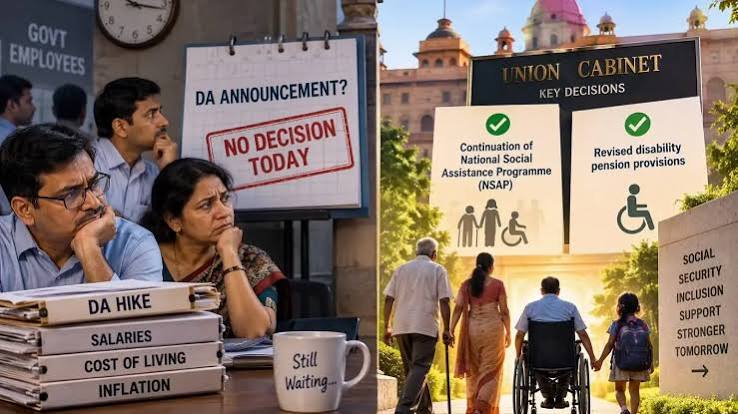
The Union government has announced a major restructuring of its flagship social security initiative, the National Social Assistance Programme (NSAP), opting to rename the entire framework to the Pradhan Mantri Samajik Sahayata Yojana. The decision, confirmed by the Cabinet on Wednesday, extends the scheme for a five-year period, effectively continuing the outreach until 2031. Alongside the overarching name change, the government has removed the name of former Prime Minister Indira Gandhi from the three core sub-schemes associated with the programme.Addressing the press, Information and Broadcasting Minister Ashwini Vaishnaw stated that the updated programme serves as a comprehensive social security net designed to provide support to vulnerable sections of society, including the elderly, widows, and persons with disabilities. The government has allocated Rs 53,428 crore for this initiative, which is projected to benefit approximately 3.2 crore individuals nationwide.The specific sub-schemes have undergone a nomenclature shift to align with the new branding. The Indira Gandhi National Old Age Pension Scheme has been rebranded as the PM Vridhavastha Pension Yojana. Similarly, the Indira Gandhi National Widow Pension Scheme is now the PM Vidhawa Pension Yojana, and the Indira Gandhi National Disability Pension Scheme has been renamed the PM Divyangjan Pension Yojana. This move follows a similar administrative trend observed last December, when the government replaced the Mahatma Gandhi National Rural Employment Guarantee Act (MGNREGA) with the Viksit Bharat–Guarantee for Rozgar and Ajeevika Mission (Gramin).Beyond the change in titles, the government has introduced significant revisions to the eligibility criteria and the financial assistance provided under the disability pension sub-scheme. The monthly allowance for beneficiaries has been increased; those aged between birth and 79 years will now receive Rs 375 per month, while beneficiaries aged 80 and above will be entitled to Rs 625. Previously, individuals aged 18 to 79 received Rs 300, and those 80 and above were provided Rs 500.Furthermore, the threshold for benchmark disability has been lowered from 80% to 40%. Officials noted that this adjustment ensures the scheme remains in compliance with the Rights of Persons with Disabilities Act, 2016, which mandates that disability-related assistance be at least 25% higher than support provided under comparable categories. It is estimated that these specific policy changes will extend coverage to more than 27.48 lakh beneficiaries.While the disability pension has seen an increase, the financial assistance provided under the old-age and widow pension schemes remains unchanged. Current support for old-age pensioners ranges from Rs 200 to Rs 500 per month, impacting over 221 lakh people, while widow pensions range from Rs 300 to Rs 500, benefiting approximately 67 lakh individuals. Additionally, the National Family Benefit Scheme continues to offer a one-time payment of Rs 20,000 to households following the death of a primary breadwinner aged between 18 and 59, covering roughly 3.59 lakh beneficiaries.The government maintains that these revisions are part of a broader effort to streamline social security delivery. By aligning the terminology and updating the eligibility framework, the authorities aim to enhance the efficacy of the support provided to India’s most vulnerable populations over the next five years.







Comments