


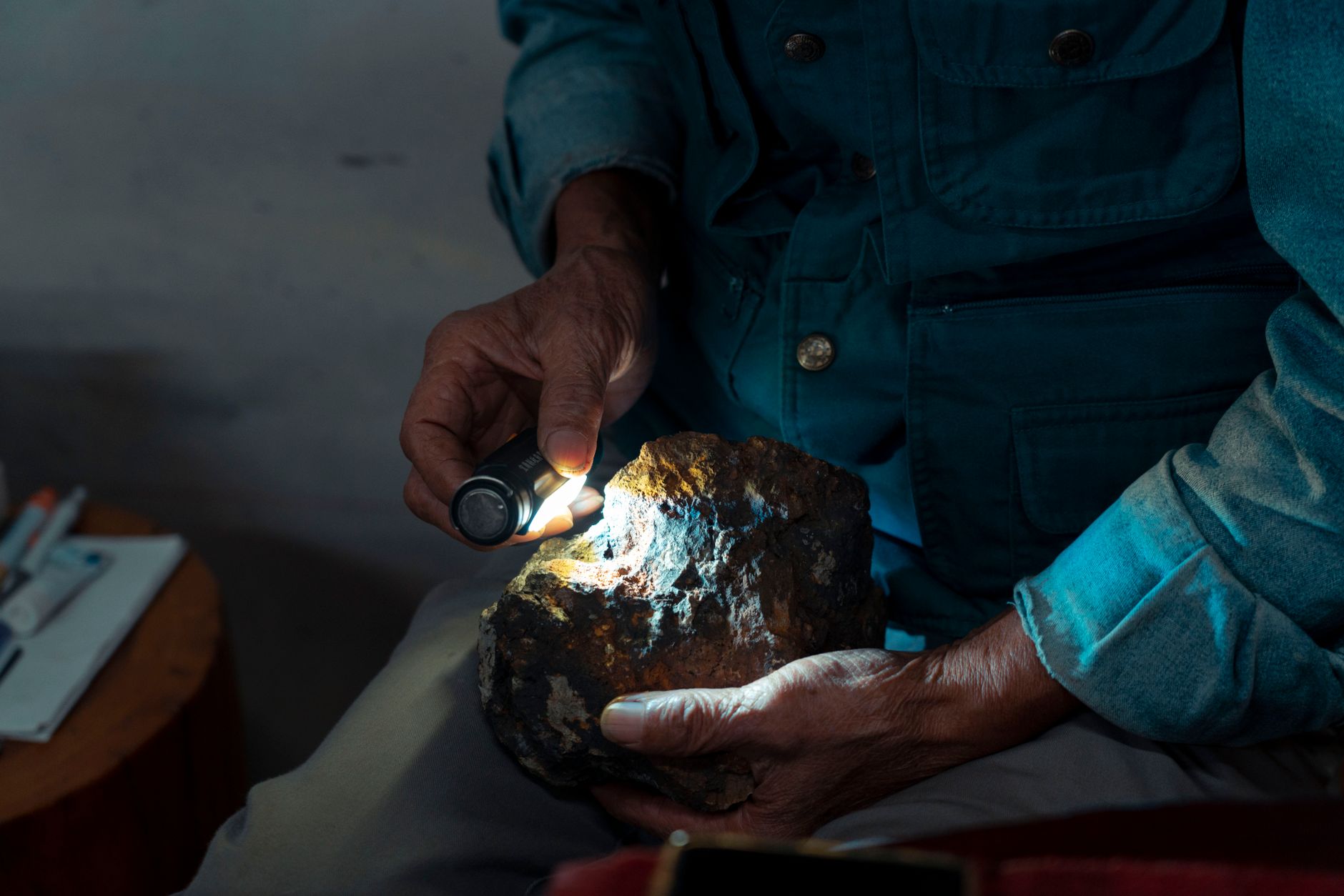
A unassuming pink rock, discovered in the Sahara Desert in 2022, has provided scientists with a rare window into the history of Mars. Now officially known as Teghaza 001, the 800-gram specimen has been confirmed by NASA-funded researchers as one of the oldest Martian meteorites ever identified on Earth. The findings, published in the journal Science, indicate that the rock formed more than 4.1 billion years ago, offering vital evidence of the planet's early geological conditions and the presence of ancient water.
When the rock was first recovered from the salt plains in Mali, its exact origin and age remained unknown. Researchers at the University of New Mexico later confirmed its Martian status by analyzing oxygen isotopes, which serve as distinctive geochemical fingerprints for planetary materials. This verification process allowed scientists to distinguish it from terrestrial rocks and other meteorites found on Earth. The specimen is now categorized as one of approximately 435 known Martian meteorites and stands out as one of the three oldest examples in the collection.
Yang Liu, a planetary scientist at NASA's Jet Propulsion Laboratory, led the effort to study the stone’s unique composition. The team utilized an advanced in-situ rubidium-strontium dating technique, which allowed them to examine individual mineral grains without needing to dissolve the entire sample. This method proved crucial in preserving most of the rare meteorite for future scientific investigation, while simultaneously establishing a precise timeline for its development. The analysis confirmed that the rock underwent significant alteration by water approximately 4.1 billion years ago, implying an even older origin for its initial formation.
The meteorite contains a complex mixture of igneous minerals, which form as molten rock cools and solidifies. Among these are zircon crystals, which are highly prized by geologists for their ability to preserve detailed information about the timing and conditions under which a rock originates. By studying these grains, the research team was able to gain new insights into how the Martian crust evolved from magma. These findings complement a separate study released in June 2026, which examined the meteorite’s water content and further solidified the link between geological activity and surface water.
Lee Saper, a co-author of the research, highlighted the significance of the find by noting that the meteorite provides a sample from a region of the Martian crust previously unrepresented in current collections. According to Saper, the rock records clear interactions between water and stone, and potentially holds traces of the Martian atmosphere from a time when the planet was in the process of losing its water. These details suggest that the water cycle on early Mars was far more dynamic than previous reconstructions based on other meteorite samples had suggested.
Despite the success in dating and identifying the rock's composition, the exact point of origin on the surface of Mars remains a mystery. Scientists have compared the chemical signature of Teghaza 001 with observational data gathered by NASA's Mars Reconnaissance Orbiter. The comparison identified 13 potential locations on the red planet that could match the meteorite's profile, with the southern highlands showing the strongest similarities. However, researchers have yet to pinpoint the precise crater or region from which the rock was ejected into space by a massive impact.
The journey of Teghaza 001 from the Martian surface to the Sahara illustrates the extreme events that periodically occur within our solar system. Following a powerful impact that threw it into space, the rock traveled through the solar system before eventually landing on Earth. Scientists continue to evaluate the specimen, as it serves as a tangible link to a period billions of years ago when Mars was fundamentally different from the cold, dry world observed today. Future studies are expected to continue probing the meteorite for further secrets regarding the evolution of planetary environments.








Comments