


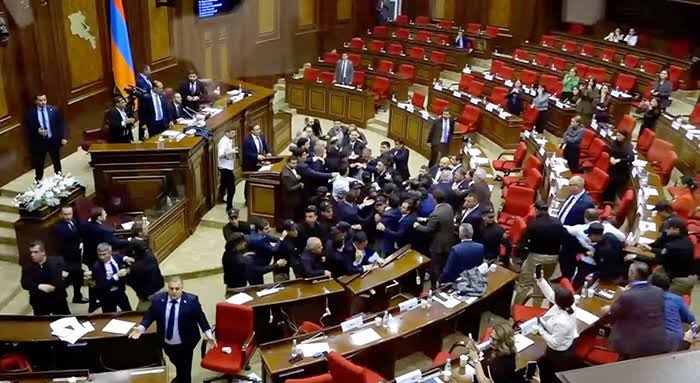
Tensions in the Armenian National Assembly reached a boiling point on Wednesday as a routine parliamentary session descended into a chaotic brawl. This marks the third time in the span of a single month that the legislative chamber in Yerevan has transformed from a place of political debate into a scene of physical confrontation. The incident, which disrupted the day's legislative agenda, occurred when a member of the ruling party made disparaging remarks regarding the family of an opposition leader, prompting an immediate and aggressive reaction from across the floor.
Witnesses within the assembly reported that the verbal sparring escalated rapidly, with several deputies rushing toward the center of the hall to engage in fisticuffs. The spectacle, which has become an increasingly concerning trend in Armenian politics, saw chairs and desks shoved aside as lawmakers traded blows in front of cameras. Security officers were eventually forced to intervene to separate the warring factions, though the atmosphere remained highly charged, ultimately leading to the suspension of the proceedings for the remainder of the afternoon.
The recurring nature of these violent episodes has raised significant questions about the state of democratic discourse in Armenia. While political disagreements are a hallmark of parliamentary systems, the rapid descent into physical violence suggests a profound breakdown in communication and mutual respect between the governing coalition and the opposition parties. Political analysts point to a climate of heightened polarization, where ideological differences are increasingly being channeled through confrontation rather than policy negotiation.
This latest brawl follows a series of similar incidents that have plagued the National Assembly in recent weeks, painting a grim picture of the country's legislative productivity. Observers have expressed alarm at the normalization of such behavior, noting that every instance of physical violence further erodes public trust in the governing institutions. The frequency of these incidents suggests that the underlying issues fueling the animosity—ranging from post-conflict trauma to deep-seated electoral grievances—remain largely unaddressed by the current political leadership.
In the aftermath of the scuffle, leaders from both sides of the aisle issued competing statements, each blaming the other for the breakdown in order. The ruling party argued that the opposition was attempting to intentionally derail the government's legislative agenda, while opposition members maintained that the provocative language used by government deputies was a deliberate attempt to incite a reaction and silence dissenting voices. Despite these finger-pointing exercises, there has been little evidence of a genuine attempt to mediate the dispute or establish a framework for civil engagement in the future.
Looking ahead, the incident puts additional pressure on the parliamentary leadership to enforce stricter codes of conduct within the chamber. While the Armenian Constitution grants immunity to lawmakers for their statements, the rules of procedure clearly prohibit the use of violence or intimidation within the parliament building. However, without a consensus on how to handle these outbursts, it remains unclear whether sanctions or disciplinary actions will be implemented to prevent further degradation of the institution's dignity.
The international community, which closely monitors Armenia's democratic progress, is likely to view these repeated brawls as a setback for the nation's political maturity. For the average citizen, the images of lawmakers fighting on the parliament floor serve as a disheartening reminder of the disconnect between the political elite and the pressing issues facing the country, such as economic recovery and regional security. As the National Assembly attempts to resume its duties, the central challenge remains whether the parties can find a pathway toward constructive debate or if the legislative environment will continue to be defined by these recurring outbursts of aggression.








Comments