


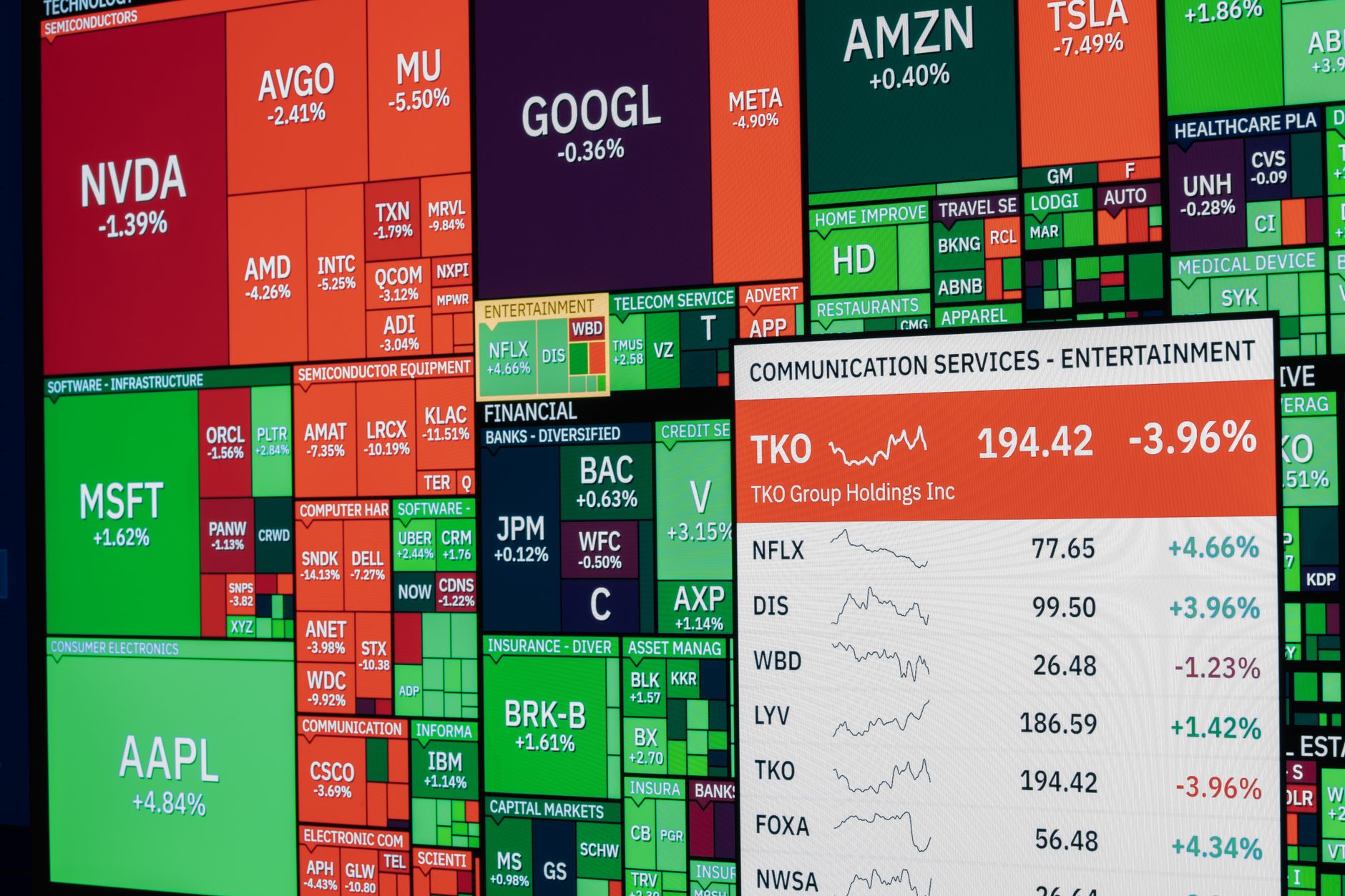
Global stock markets have experienced a notable climb as investors continue to commit capital to the artificial intelligence sector, betting on the long-term prospects of major technology firms driving the ongoing boom. This renewed confidence manifested in significant gains across both United States and Asian exchanges throughout the week, as participants monitored major earnings reports and sector-specific performance.
In the United States, all three major stock indexes saw an upward trend on Tuesday. The tech-heavy Nasdaq Composite led the movement with a rise of 1.18 percent. The S&P 500 followed, gaining 0.6 percent, while the Dow Jones Industrial Average saw a modest increase of 0.03 percent. Among the "Magnificent Seven" tech stocks, Tesla emerged as a standout performer, rising by 4.04 percent. Other significant movers included Amazon, which gained 1.61 percent, along with Apple and Alphabet, which recorded increases of 0.93 percent and 0.9 percent, respectively. Notably, Nvidia saw its valuation increase by nearly 1 percent following an announcement regarding a $3 billion investment in Meta’s equity offering.
The momentum extended to Asia-Pacific markets, where major indexes tracked the positive performance from Wall Street on Wednesday. South Korea’s KOSPI index recorded a robust gain of 6.63 percent. This surge was primarily fueled by SK Hynix, one of the world’s leading memory chip manufacturers, which reported a 630 percent year-on-year increase in operating profit, reaching 83.33 trillion won, or approximately $62.4 billion. Shares of SK Hynix rose by 10.89 percent in response to the announcement. Similarly, Japan’s Nikkei 225 climbed 1.08 percent, Taiwan’s TAIEX rose by 2.04 percent, and Hong Kong’s Hang Seng Index saw a gain of 0.33 percent.
Market analysts suggest that the performance of specific tech firms continues to serve as an indicator for broader market sentiment. Dan Coatsworth, head of markets at AJ Bell, noted that rising values in AI-related stocks—such as CoreWeave, Western Digital, and Super Micro Computing—signal that the current investor appetite for the technology remains high. "These types of stocks have become a litmus test for the mood of the market," Coatsworth said, adding that while these assets typically decline when investors fear the AI narrative is losing momentum, their recent gains suggest that confidence persists.
Despite the current enthusiasm, industry observers remain divided on whether this trend represents the beginning of a sustainable rally or merely a relief bounce. There is ongoing debate regarding the scale of investments in AI infrastructure, with some experts drawing parallels to the speculative environment of the 2000 dot-com era. Data from Gartner indicates that global AI investment is expected to reach $2.7 trillion in 2026, with projections rising to $3.6 trillion in 2027.
The market landscape is now shifting toward the next round of corporate financial disclosures. Microsoft and Alphabet are scheduled to release their latest results on Wednesday, followed by Amazon on Thursday and Apple early next week. Additionally, the industry is closely watching Anthropic, which recently filed paperwork for its initial public offering, reporting a net loss of $80.7 billion on $16.3 billion in revenue during the first half of 2026.
Outside of the technology sector, broader market volatility continues to be influenced by geopolitical tensions. Oil prices rose by nearly 2 percent amid ongoing hostilities in the Middle East, including conflicts involving Saudi Arabia and Yemen’s Iran-aligned Houthis. Brent crude futures have exceeded $116 a barrel, a figure representing a more than 60 percent increase compared to price levels observed before the onset of the US-Israel war on Iran.








Comments