


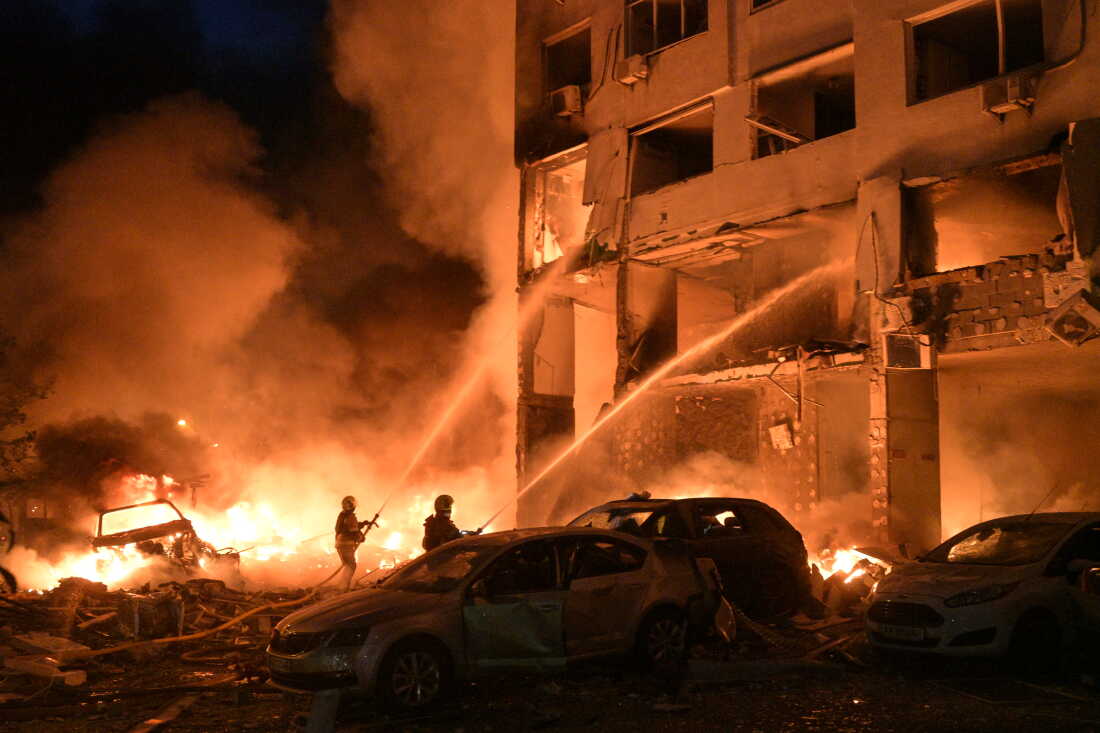
Russia launched a significant nighttime ballistic missile barrage against the Ukrainian capital, Kyiv, resulting in widespread damage to civilian infrastructure and energy facilities. The assault, which took place overnight, saw 21 ballistic missiles launched in three distinct waves, according to Ukrainian President Volodymyr Zelenskyy. The strikes impacted apartment buildings, shopping centers, businesses, a railway station, and sections of the city's subway system. One individual was confirmed dead in the capital as a result of the offensive.
Beyond Kyiv, the Russian aerial campaign extended across 12 regions of Ukraine, further complicating an already dire humanitarian situation. In the northeastern Kharkiv region, local authorities reported that a strike on a market in the town of Lozova resulted in the deaths of two women, aged 50 and 60, with dozens of others sustaining injuries. The State Emergency Service confirmed an additional fatality elsewhere in the Kharkiv region. Ukrainian officials stated that the total number of wounded across the country includes five children.
In a separate development regarding the aerial conflict, the Russian military announced on Thursday that its air defense systems had successfully intercepted more than 800 drones launched by Ukraine toward Moscow and other cities. This report of large-scale drone activity highlights the intensity of the ongoing aerial hostilities. President Zelenskyy noted that the Russian strikes on Kyiv specifically included three ballistic missiles equipped with cluster munitions, which disperse numerous smaller bomblets upon detonation.
The latest escalation occurs against a backdrop of diplomatic maneuvers. On Wednesday, Russian President Vladimir Putin reportedly agreed "in principle" to resume three-way negotiations involving Russia, Ukraine, and the United States. This development followed discussions in St. Petersburg between President Putin and Steve Witkoff, a special envoy for U.S. President Donald Trump, who had previously met with President Zelenskyy in Norway. While the potential for new talks is being explored for a period after November 10, no firm dates have been established.
Previous attempts at "technical" negotiations held in Switzerland and the United Arab Emirates earlier this year saw minimal progress, largely restricted to prisoner-of-war exchanges. Despite the United States suggesting the United Arab Emirates as a potential venue for future discussions, the two warring nations remain significantly divided on the terms required to cease hostilities. President Zelenskyy has maintained that a meeting between leaders is the only viable path to breaking the current deadlock.
The timing of these intensified strikes coincides with concerns regarding the upcoming winter season. Ukraine has accused Russia of intentionally "weaponizing winter" by targeting the nation’s power grid to deprive civilians of essential heating, light, and running water. According to President Zelenskyy, Russia has conducted 170 strikes on critical energy infrastructure since October 11 alone.
In response to the barrage, the Ukrainian government has continued to call for increased international support, specifically requesting additional Patriot air-defense ammunition from Washington. President Zelenskyy also urged the implementation of further sanctions against Russia to increase pressure on Moscow to halt the conflict. The Ukrainian president characterized the recent attacks as evidence that Russia has not altered its war strategy or signaled a genuine intent to pursue peace.







Comments