


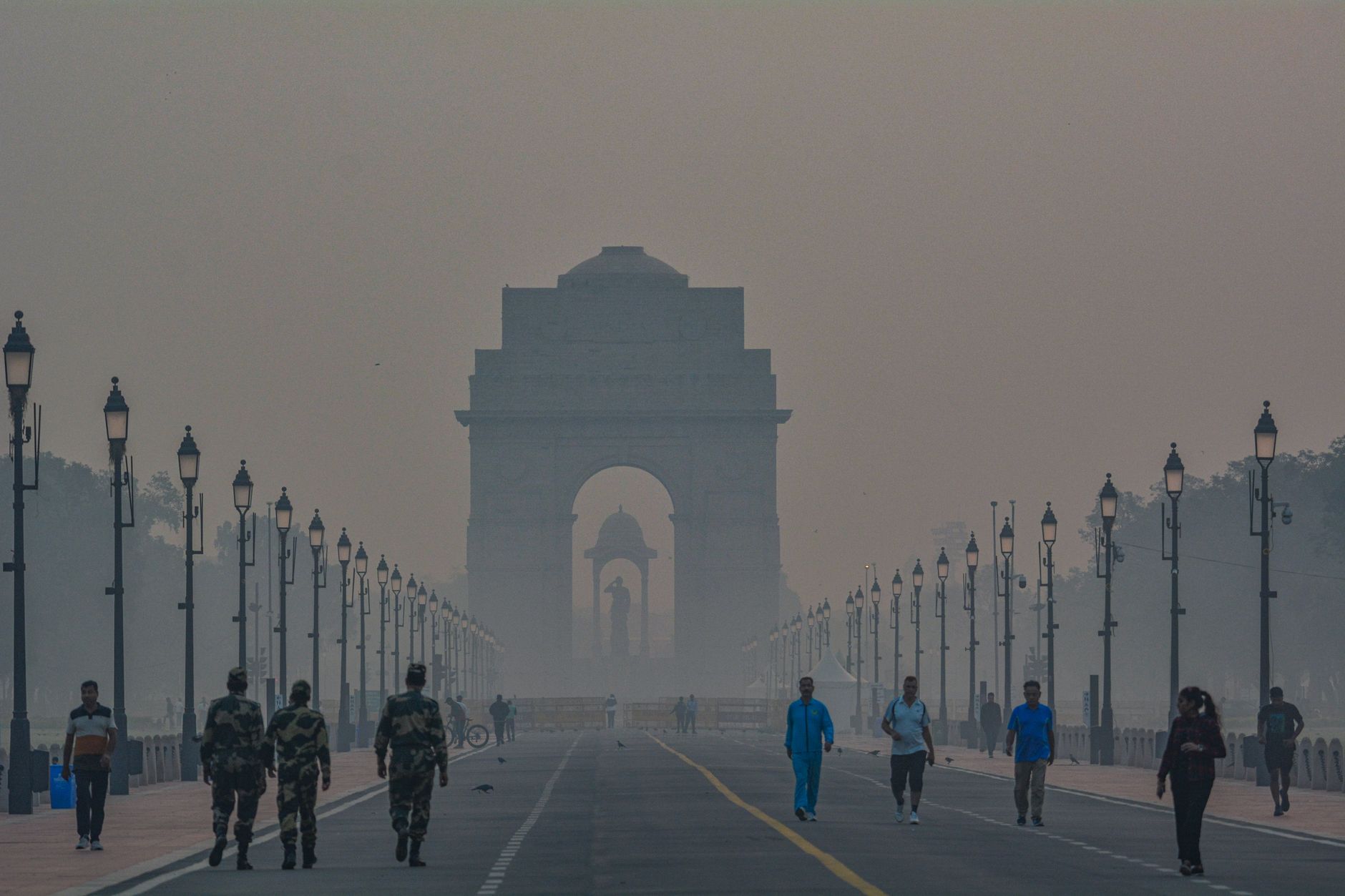
Delhi residents are bracing for a period of deteriorating air quality as the national capital's Air Quality Index (AQI) is forecast to slip into the 'poor' category for the first time this season by Monday. While the city recorded an AQI of 187 on Sunday, which sits at the higher end of the 'moderate' bracket, environmental conditions are expected to worsen in the coming days as weather patterns shift across the region.
Official data reveals that while the city-wide average remains within the moderate range, localized pollution levels have already signaled the change. On Sunday, 22 specific locations across Delhi were already reporting 'poor' air quality. Notably, the ITO area recorded an AQI reading of 430, placing it in the 'severe' category. Other locations, including Vivek Vihar, RK Puram, and Jahangirpuri, also recorded elevated levels, further highlighting the localized intensity of the current atmospheric pollutants.
The Air Quality Early Warning System, operating under the Union Ministry of Earth Sciences, has indicated that the AQI is likely to remain in the 'poor' category from Monday through Wednesday, with a similar trend expected to persist for the following six days. The transition to 'poor' air quality typically triggers the implementation of Stage I of the Graded Response Action Plan (GRAP), a set of emergency measures designed to mitigate pollution sources when air quality degrades.
Meteorological factors are playing a significant role in this decline. Following a period of rainfall that improved the air quality to 'satisfactory' levels of 90 on Friday, conditions began to deteriorate once the showers ceased. With wind speeds expected to slow down significantly, the dispersion of pollutants is likely to be hindered, contributing to the rise in the index. The city’s maximum temperature was recorded at 31.7 degrees Celsius on Sunday, with forecasts suggesting it will remain between 31 and 33 degrees Celsius over the next two days. The minimum temperature, currently near 18.6 degrees Celsius, is expected to remain consistent.
The Decision Support System, which tracks the origins of particulate matter, notes that the influence of stubble burning is currently minimal, accounting for only 0.2 percent of the pollution load. However, this contribution is projected to rise significantly, potentially reaching 12 percent by Wednesday. Currently, the primary drivers of PM2.5 levels in the city remain internal, with the transport sector identified as the leading contributor, accounting for 23.2 percent of the recorded emissions on Sunday. Industrial emissions from neighboring Gautam Budh Nagar and Ghaziabad also contributed 8.7 percent and 8.4 percent, respectively.
This expected shift marks the first significant dip in air quality since early October. Previously, on October 4, the city recorded an AQI of 187. The last time the air quality reached the 'poor' classification of 246 was on July 24, an event that was attributed to long-range dust transport from Iran, Afghanistan, and Pakistan. Authorities continue to monitor the situation as the city enters a week of potentially stagnant air conditions.








Comments