


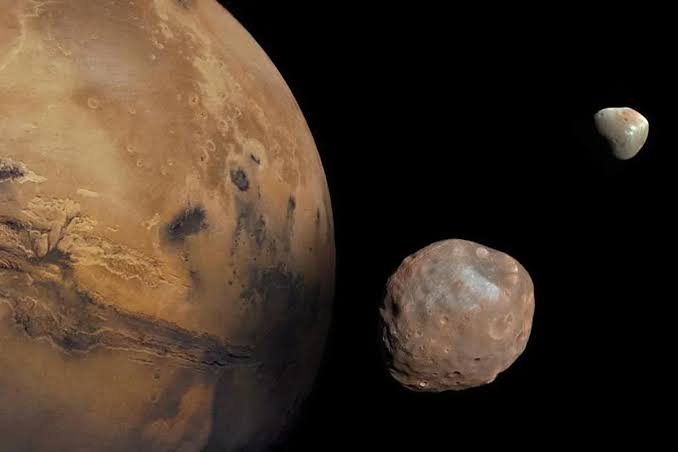
Japan has embarked on a landmark space exploration endeavor, launching a spacecraft intended to land on Phobos, one of the two moons orbiting Mars, to retrieve and return soil samples to Earth. The mission, led by the Japan Aerospace Exploration Agency (JAXA), successfully lifted off on Tuesday aboard the country's new H-3 rocket from the Tanegashima Space Center. This initiative represents the world's first attempt to collect material from the Martian moon, a feat that has remained elusive for international space agencies since the 1960s.
The mission is estimated to span five years, during which researchers aim to address long-standing questions regarding the composition and origin of Phobos and its sibling, Deimos. Scientists are currently divided on the formation of these crater-pocked, potato-shaped bodies. One prevailing theory suggests they are the result of debris generated after a large celestial object struck Mars, while others propose that the moons originated as asteroids from elsewhere in the solar system. By analyzing the collected soil, the team hopes to resolve this uncertainty and potentially gain deeper insights into the origins of life in the solar system.
JAXA officials selected Phobos for sample collection primarily because its proximity to Mars suggests it may contain more significant geological data linked to the planet. According to project estimates, approximately 0.1% of the material gathered from the moon is expected to be debris from Mars. This Martian material is considered highly valuable for researchers, as it could provide foundational data for planning future human-crewed missions to Mars. Project manager Yasuhiro Kawakatsu noted that while these moons are critical to understanding the Martian system, they have never been fully investigated, describing them as the most important unclimbed mountains in the solar system.
The operation is an international collaboration, with JAXA leading the mission while receiving technical equipment and communications support from NASA and other international space agencies. The endeavor follows several unsuccessful attempts by Russia to land on Phobos, including a notable failed mission in 2011. Despite the treacherous and low-gravity terrain that characterizes Phobos, Japanese scientists remain optimistic about the mission's prospects.
Beyond its scientific value, the mission is being closely watched as major space powers, including the United States and China, consider the feasibility of sending astronauts to the Red Planet. Data regarding the feasibility of using Martian moons as a base for human operations is a secondary but vital goal of the mission. Principal investigator Kiyoshi Kuramoto expressed confidence in the team's objective, stating that analysis of the soil samples would almost certainly lead to a definitive conclusion regarding the formation of the moons.
As the spacecraft journeys toward its destination, the global scientific community anticipates that the findings will help clarify the relationship between Phobos and Deimos. With Phobos measuring roughly 20 to 30 kilometers in diameter and orbiting Mars at a distance of 6,000 kilometers, the technical requirements for a successful landing and sample return are significant. If successful, the return of these samples will mark a historic milestone in the exploration of the Martian environment.








Comments