


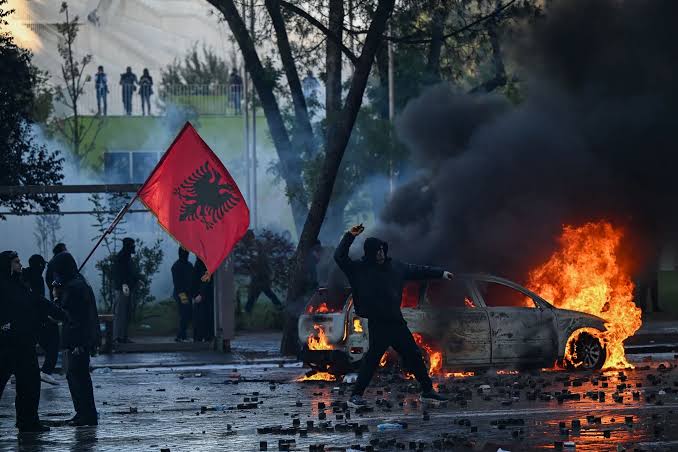
Violent clashes between protesters and riot police have gripped the Albanian capital, Tirana, for the fifth consecutive day. The unrest, which initially began in the summer, has transformed into a broad anti-government movement. Demonstrators, a significant portion of whom are high school and university students, gathered in the city center on Saturday to demand the resignation of Prime Minister Edi Rama, citing widespread corruption allegations linked to his administration.
The scene in Tirana has increasingly resembled a conflict zone, with streets littered with broken glass and debris. On Saturday, masked protesters focused their efforts near the education ministry and the Prime Minister’s office on the city’s main boulevard. Clashes intensified as demonstrators hurled rocks, fireworks, and petrol bombs at police lines. In response, authorities deployed water cannons, tear gas, and, according to reports, rubber bullets to disperse the growing crowds.
As tensions escalated, the government brought in special forces to reinforce riot police. The sound of exploding petrol bombs, sirens, and the thick presence of smoke created a chaotic atmosphere. Protesters utilized gas masks and saline eyewash to mitigate the effects of the tear gas. Both police and civilians have reported injuries during the confrontations. Authorities confirmed that 80 individuals have been charged with disorder, while hundreds of others remain under arrest or subject to investigation.
The current movement is driven by a profound dissatisfaction with the political status quo. Many protesters argue that they are standing against the entire political class. Prime Minister Edi Rama, whose Socialist Party holds a significant majority of 83 out of 140 seats in parliament, has maintained power for 13 years. In response to the unrest, Rama took to social media to blame the opposition Democratic Party and unspecified "foreign actors" for attempting to derail Albania’s path toward European Union membership, a goal he has targeted for 2030.
The Prime Minister’s administration is also facing pressure from the special prosecution service, which was established in 2019 under pressure from the EU and the United States. Recent investigations have led to the arrest of the head of the secret service, Vlora Hyseni, on allegations of assisting a businessman, Ergys Agasi, in evading justice. While Agasi has denied all allegations of corruption through his lawyer, media outlets have raised questions regarding his alleged ties to organized crime and his relationship with the Prime Minister. Rama has acknowledged knowing Agasi but explicitly denies any knowledge of illegal activity.
Political analysts suggest that Rama finds himself in a difficult position. Having concentrated substantial power within his office, he has become the primary target for public grievances. The protesters, meanwhile, show little sign of backing down. Students have been boycotting classes, and some have explicitly framed their actions as a "revolution," arguing that peaceful methods have failed to produce change. Calls have emerged for a neutral, caretaker government to be installed for one year to organize fresh elections.
Despite the calls for his departure, the next parliamentary elections are not scheduled until 2029. The current cycle of violence continues to challenge Rama's reputation as a leader guiding Albania toward economic stability. As the situation remains volatile, the capital waits to see whether the government will initiate dialogue or if the cycle of protests and police crackdowns will persist in the coming days.








Comments