


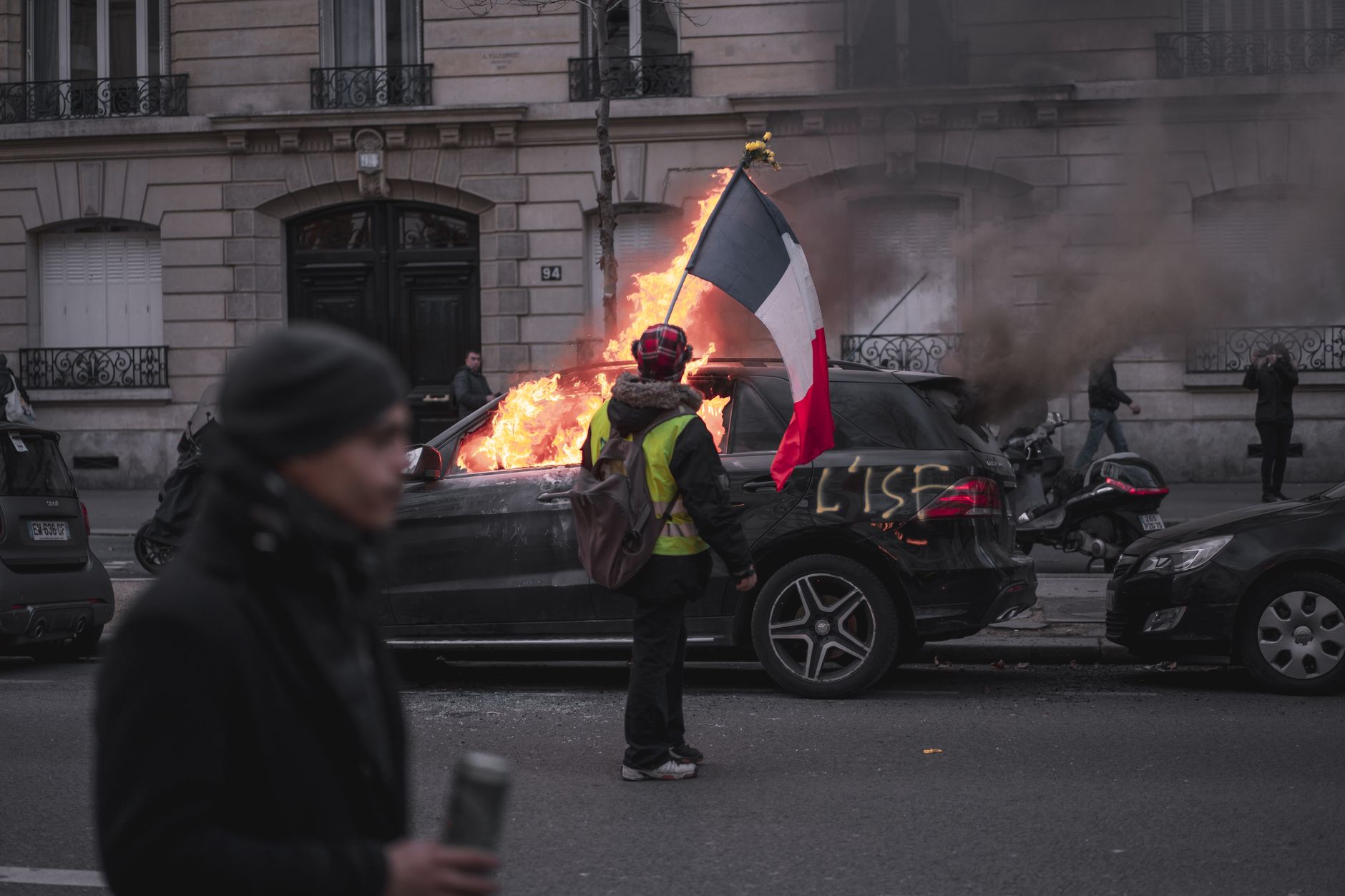
Widespread protests against rising living costs escalated into violence across France on Saturday, prompting a heavy police response and leading to more than 270 arrests. According to the country’s interior ministry, the demonstrations—which saw the return of the "yellow vest" movement—were marred by assaults on police officers, the looting of shops, and damage to public infrastructure and government buildings.
In Paris, the atmosphere at the historic Place de la République turned volatile as protesters clashed with security forces. Videos from the site captured demonstrators scaling a large statue to unfurl an anti-police banner. Meanwhile, thick plumes of smoke rose from the surrounding streets as vehicles, bicycles, and kiosks were set ablaze. Authorities deployed tear gas and water cannons to disperse groups of masked individuals who were reportedly throwing fireworks and paving stones at officers.
The unrest extended well beyond the capital. In Lyon, France’s third-largest city, a fire erupted inside a tourist office as thousands participated in marches. In Marseille, protesters briefly gained access to the lobby of City Hall, causing damage that Mayor Benoît Payan later described as limited. Further reports of violence involving masked groups emerged from Rennes, Toulouse, Montpellier, and Grenoble, as police struggled to prevent crowds from congregating near government offices and presidential sites.
Despite the widespread scenes of destruction, many participants maintained that the demonstrations were fundamentally peaceful. Large marches proceeded with protesters waving flags, chanting the national anthem, and playing music. The rallies were driven by mounting frustration over sharp increases in the prices of gasoline, energy, and food. Participants expressed deep grievances regarding the perceived neglect of essential public services and government policies they claim disproportionately favour the wealthy.
The protests follow weeks of coordinated school blockades and student-led demonstrations that have been ongoing since mid-September. These earlier actions, which have resulted in numerous injuries and the setting of fires at school premises, have drawn significant public attention and become a central issue in the current presidential election campaign. Some teenagers have sustained serious injuries during confrontations involving police riot-control weapons.
Support for Saturday’s actions came from various sectors, including the CGT, one of the country's most prominent labour unions. The organization advocated for higher wages and pensions, a reduction in the cost of living, and the protection of public services. The union estimated that approximately 500,000 people took part in the demonstrations nationwide. Far-left presidential candidate Jean-Luc Mélenchon also participated in the Paris protests, signaling the political weight the movement has gained.
As authorities attempt to restore order, the government faces increasing pressure to address the underlying economic grievances of the protesters. Several metro stations in Paris, particularly those near sensitive government zones such as the presidential palace and parliament, were closed at the request of police to contain the crowds. With tensions remaining high and the influence of both student groups and unions continuing to grow, the situation in France remains volatile as the country enters this period of intense social and political scrutiny.







Comments